
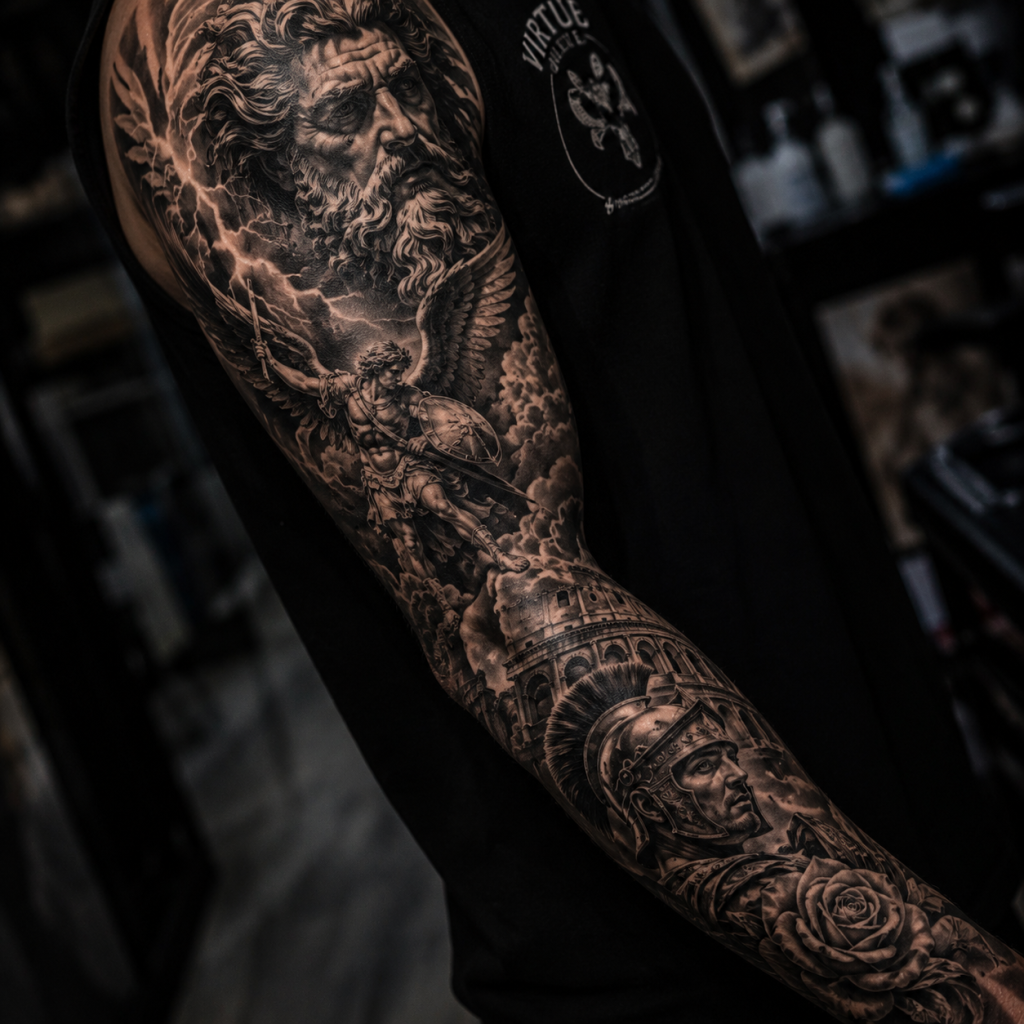
A sleeve is one of the biggest commitments you can make to your skin, and once the first session starts, there’s no easy way to scale it back. This guide breaks down what actually goes into sleeve tattoos for men: cost, sessions, style choices, and healing, so you know what you’re signing up for before you book.
What Counts as a Sleeve Tattoo?
A sleeve isn’t one tattoo. It’s a connected body of work that covers a significant portion of the arm, and the scope can vary a lot.
- Half sleeve: Shoulder to elbow, or elbow to wrist
- Full sleeve: The entire arm as one continuous piece
- Custom composition: Individual elements (a dragon, a portrait, abstract linework) flow into each other rather than sitting as separate tattoos
Negative space (the bare skin left intentionally untattooed), shading, and transitions all have to be planned from the start, which is why sleeves are almost always built as custom work rather than picked off a flash sheet (a pre-drawn design displayed in-studio).
How Much Do Arm Tattoos for Men Cost?
There’s no flat number for a sleeve, and anyone who quotes one without seeing your arm first probably hasn’t thought it through.
Cost comes down to a handful of factors:
- Size and coverage: Half sleeve versus full sleeve changes the scope significantly
- Level of detail: Fine linework and photorealism take more time per square inch than bold, graphic styles
- Colour versus black and grey: Colour work generally adds sessions
- Artist specialty: A realism specialist and a linework specialist don’t charge the same way, since the technique and time investment differ
This is one of the reasons a proper consultation matters. It lets an artist actually look at your skin, your idea, and your timeline before giving you a number that means something. Our Tattoo artists each bring a different specialty to the table, which is worth factoring into your decision alongside price.

How Many Sessions Does a Full Tattoo Sleeve Take
Sleeves are rarely a one-sitting project.
Full Sleeves
Most full sleeves are built across multiple sessions spread over weeks or months, both to manage the physical toll on your arm and to give the artist room to adjust the design as it develops.
Half Sleeves
Half sleeves tend to move faster since there’s less surface area to cover, but the same principle applies: quality work takes the time it takes. Rushing a large-scale piece into fewer, longer sessions usually shows up in the healed result, particularly in shading and line consistency.
Choosing a Style for Your Sleeve
Choosing your tattoo style shapes everything else, from session count to how the design ages over time.
- Greyscale: Leans on shading and contrast rather than colour; tends to read as timeless
- Neo-Asian: Works well for larger canvases, since motifs like dragons, koi, and florals were traditionally designed to wrap around the body
- Realism: Demands more precision per session
- Illustrative and black linework: Often move faster due to graphic simplicity
None of these are mutually exclusive. Plenty of sleeves blend two styles, like realism with illustrative accents, as long as the transitions are planned before the first line goes down. This is exactly what a custom tattoo process is built for: working through the concept with you until the design actually fits your arm and your vision.
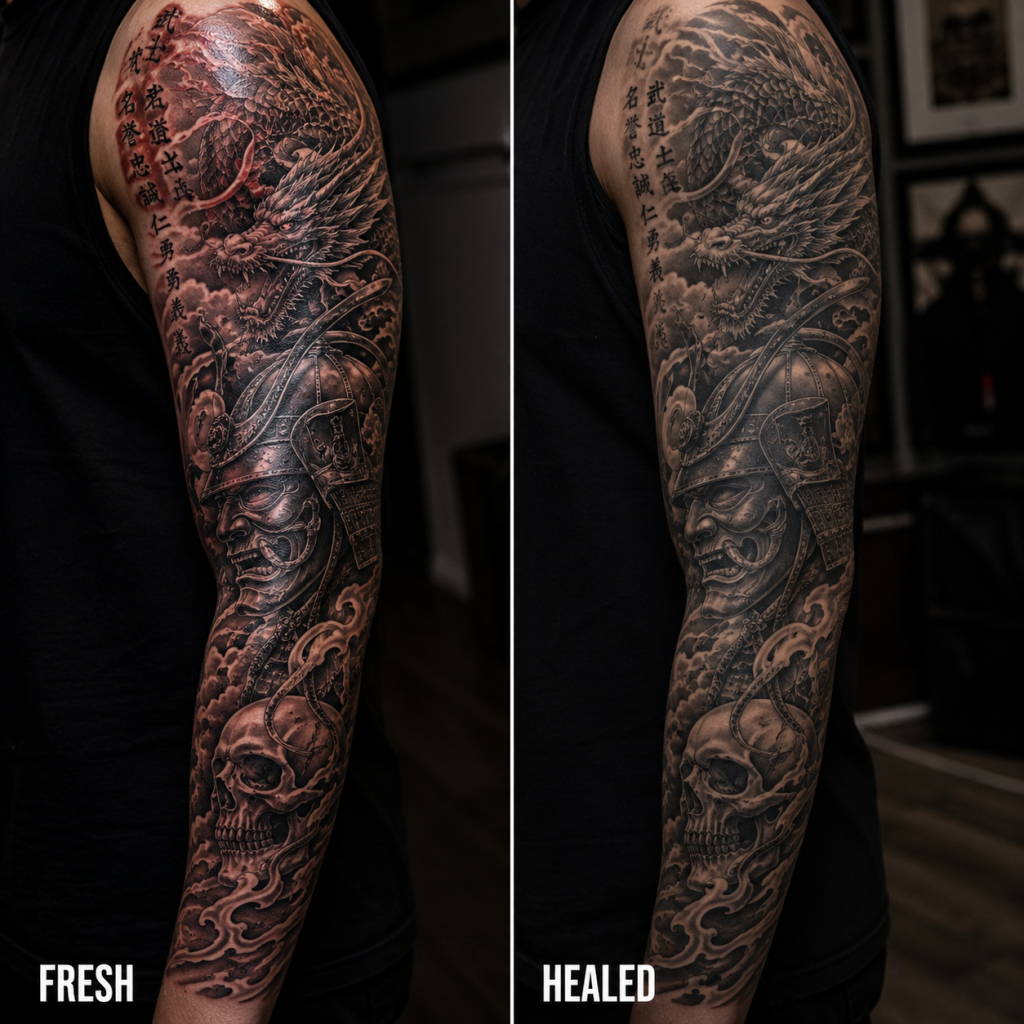
Pain, Healing, and Aftercare
Getting the tattoo is only half the process; how it heals determines how it looks for the next fifty years.
Pain by Placement
Pain varies by placement more than most people expect. The inner arm and elbow crease tend to be more sensitive because the skin is thinner and closer to bone or nerve endings, while the outer arm and shoulder are generally more tolerable. A full sleeve touches both, so expect some sessions to feel different from others.
Healing Timeline
Healing follows a fairly predictable pattern: the surface heals within a couple of weeks, but the skin continues settling underneath for a month or more. Following your artist’s aftercare instructions during that window matters more than people think, since poor aftercare is one of the most common causes of patchy healing or colour loss.
Health and Safety Standards
Choosing a studio that follows proper health protocols isn’t optional. Fraser Health inspects and approves personal service establishments, including tattoo studios, specifically because procedures that break the skin carry infection risk if hygiene standards aren’t met. Tattoo inks themselves are also regulated in Canada: Health Canada treats them as cosmetics subject to compliance testing, which is part of why sourcing ink matters as much as sourcing a skilled artist.
Is a Sleeve Tattoo Right for You?
A sleeve is a long-term relationship with an idea, not a single afternoon decision. Before committing, a few things worth weighing honestly:
- Career visibility: Does your workplace or industry have concerns about visible ink?
- Design cohesion: Are you drawn to one connected concept, or several smaller ideas that don’t need to line up?
- Time commitment: Are you comfortable spreading the work across multiple sessions over weeks or months?
If the answer keeps coming back to “yes, I want this,” the next right step isn’t picking a design off Pinterest. It’s sitting down with an artist who can tell you what will actually work on your arm, your skin tone, and your timeline.
Ready to talk through your idea? Book a consultation, and we’ll help you figure out what a sleeve tattoo could look like on you.
Frequently Asked Questions
1. Will a tattoo on my forearm stretch or distort over time?
Some shifting is normal as skin ages, especially with weight changes, but a well-executed tattoo on a stable area like the forearm holds up better than most people expect. Good linework and shading depth from the start make a real difference in how it ages.
2. Can I get a sleeve tattoo done in one long session?
Technically yes for smaller sections, but most artists won’t recommend it for a full sleeve. Long single sessions increase swelling and skin trauma, which can affect how cleanly the piece heals.
3. Do I need to plan the whole sleeve before starting?
You don’t need every detail locked in, but having a general theme or style direction before your first session helps the composition flow instead of looking like separate tattoos stacked together.
4. How painful is a sleeve tattoo compared to smaller pieces?
It’s not necessarily more painful per minute, but the cumulative time on the skin is longer, and certain spots like the inner elbow are more sensitive than others. Most clients find it manageable in planned sessions.
5. Can I add to an existing arm tattoo to build it into a sleeve?
Often, yes. An experienced artist can work an existing piece into a larger composition, though it takes more planning than starting from a blank arm since the new work has to complement what’s already there.
Key Takeaways
- Sleeves are custom compositions, not a collection of separate tattoos, so plan the concept before booking.
- Cost depends on size, detail level, and artist specialty rather than a flat rate.
- Full sleeves are typically built across multiple sessions over weeks or months.
- Style choice affects both how the piece ages and how quickly it can be completed.
- Aftercare during the first month has a direct impact on how well the tattoo heals.
- A consultation before your first session gives you a realistic timeline and cost range.